
Arlington Kitchen Renovation Financing Options

Financing can make a kitchen renovation manageable without delaying the work until you’ve saved the full amount. Arlington kitchen renovation financing is worth considering when spreading payments fits your budget, but compare the total borrowing cost and repayment risk, not just the advertised monthly payment. A kitchen remodel’s average return is 59% to 81.1%, though that figure alone can’t tell you whether financing is right for your household.
It’s reasonable to want a more functional, refreshed kitchen without taking on payments that create pressure later. The right approach to Arlington kitchen renovation financing depends on your project scope, repayment timeline, and the terms you qualify for.
This guide explains why homeowners finance kitchen projects, how contractor financing and deferred interest work, and what lenders may consider when reviewing applications. You’ll also see how financing decisions can apply to kitchen and bathroom remodeling, helping you compare terms and plan your next steps.
Table of Contents
Why Consider Financing Your Kitchen Project?
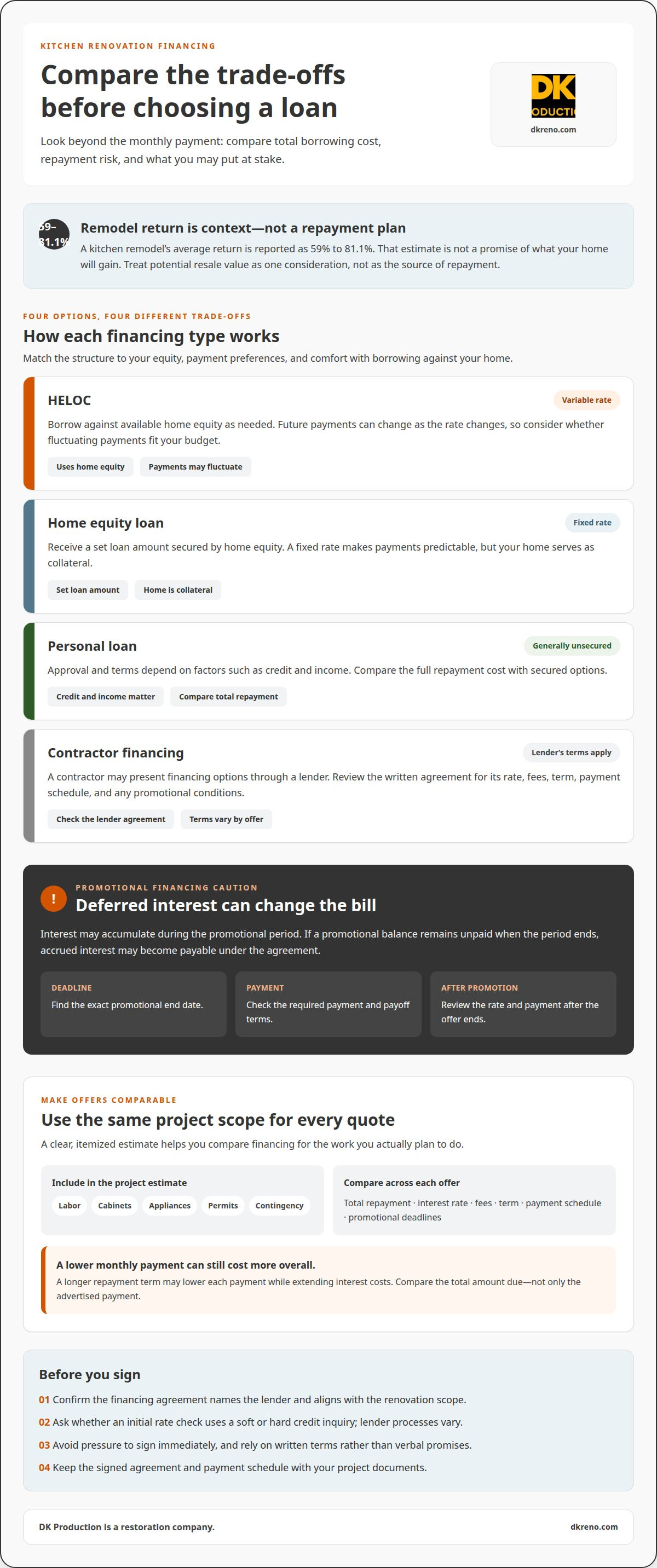
Financing can spread a kitchen project’s payments over time instead of requiring the full amount upfront. A sound Arlington kitchen renovation financing plan starts with your home equity, repayment preferences, and ability to manage the payment. A kitchen remodel’s average return is 59% to 81.1%, but that estimate isn’t a promise of what your home will gain. Treat potential resale value as one consideration, not your repayment plan.
Compare the main financing options by how they work and what they put at stake:
HELOC: A home equity line of credit lets you borrow against available equity as needed. Its variable rate can make future payments change, so consider whether fluctuating payments suit your budget.
Home equity loan: This provides a set loan amount secured by home equity. A fixed rate gives you predictable payments, while your home serves as collateral.
Personal loan: This is generally unsecured, so approval and terms depend on factors such as credit and income. Compare its full repayment cost with secured options.
Contractor financing: Financing may be offered through a lender working with a contractor. Review the agreement’s rate, fees, term, payment schedule, and promotional conditions.
Contractor financing offers are easier to compare when the project scope is clear. Start with an itemized estimate covering labor, cabinets, appliances, permits, and a contingency. Then compare each offer’s total repayment, interest rate, fees, term, and monthly payment. A lower payment can still mean higher total borrowing costs if repayment takes longer.
GreenSky is one named home-improvement financing option, but its terms depend on the specific offer. Read the lender’s agreement rather than relying on a contractor’s summary. Check whether the quoted rate is promotional, when repayment begins, and how payments change afterward. Also ask whether an initial rate check involves a soft or hard credit inquiry, since lenders vary.
To prepare an application, gather an itemized project estimate and information about your income, current debts, and credit. Lenders use these details to assess repayment capacity and available terms. A defined scope helps you request financing that reflects the planned kitchen work, rather than an unclear amount. For Arlington kitchen renovation financing, this preparation also makes offers easier to compare.
Compare contractor financing offers side by side, reviewing the lender, total repayment, fees, payment dates, and promotional deadlines. To reduce scam risk, avoid pressure to sign immediately, confirm that the financing agreement names the lender, and don’t rely on verbal promises that conflict with the written terms.
Contractor financing and deferred interest
Contractor financing can connect a renovation project with a lender’s payment plan. The contractor may present options, while the lender sets approval terms and repayment conditions. Treat the financing agreement as separate from the renovation scope. Review both documents to ensure the amount financed, payment schedule, and description of the work align.
Deferred interest changes how promotional financing works. Interest may accumulate during the promotional period, even if regular payments are required. If any promotional balance remains unpaid when that period ends, accrued interest may become payable under the agreement. Before accepting, read the exact deadline, required payment, and post-promotion rate. A low introductory payment alone doesn’t show the total cost.
A fixed-rate offer keeps the interest rate predictable for the stated loan term, which can help with budgeting. However, a fixed rate alone doesn’t reveal the total repayment. Compare the annual percentage rate, fees, term, payment schedule, and total amount due. A longer term may lower each payment while extending interest costs.
Some financing offers advertise an AutoPay discount. Check whether it applies to the interest rate or another charge, and whether you must enroll by a stated date. Read what happens if an automatic payment is returned or stopped. Compare the scheduled payment with and without the discount, then consider whether its conditions fit your regular banking routine.
Interest rates vary by financing product and lender. A HELOC may have a variable rate, while a fixed-rate home equity loan keeps its rate steady during the loan term. Contractor-arranged financing may include promotional or standard-rate options. Compare the written offer’s rate structure, fees, payment amount, and repayment period. Ask whether an initial rate check involves a soft or hard credit inquiry, since lender processes vary.
Interest on a kitchen renovation loan isn’t automatically deductible just because the funds paid for remodeling. Tax treatment depends on the loan structure and applicable tax rules, so don’t count a potential deduction as guaranteed savings in your budget.
Before signing, place each offer side by side and mark its promotional end date, rate after promotion, minimum payment, and payoff terms. Keep the signed agreement and payment schedule with your project documents. A clearly defined kitchen renovation project scope can help you understand what the financing is intended to cover.
Credit, income, and debt-to-income qualification factors
Lenders review credit and repayment capacity when assessing renovation applications. These factors help explain how they may evaluate your financial profile.
Credit Qualifications
Credit history helps lenders assess how you’ve managed borrowed money. They may review payment patterns, outstanding balances, account history, and recent applications. A late payment or high balance may affect applications differently across lenders, so no single score guarantees approval. Review your credit information before applying and correct any errors through the appropriate reporting process.
Ask which credit factors the lender considers and whether an initial rate check involves a soft or hard inquiry. Processes vary by lender. A soft inquiry generally doesn’t affect your credit score, while a hard inquiry can appear on your credit report. Knowing which check is planned helps you understand the application process before authorizing it.
Income and Debt-to-Income Factors
Income helps lenders assess whether a proposed payment fits your finances. They may consider income sources, consistency, existing monthly debts, and the requested loan amount. Debt-to-income ratio compares monthly debt obligations with gross monthly income. Lower existing obligations may leave more room in a lender’s assessment, while a renovation payment adds to monthly commitments.
The listed partner HELOC terms require a debt-to-income ratio of no more than 43% as of July 2026. That limit applies to those listed HELOC terms, not automatically to every loan type. Before applying, account for recurring debts and the proposed payment. A detailed household budget can help you see how a changed payment would affect other commitments.
Options for Bad Credit or No Money Down
Bad credit or limited savings can narrow available offers, but the lender’s criteria determine your options. A personal loan, home equity product, or contractor-arranged plan may use different qualification standards. Compare credit requirements, payment terms, fees, and collateral implications. Don’t assume a no-money-down offer costs less, since financing more of the project can increase total repayment.
If your application is declined, identify the stated reasons before choosing another offer. A smaller financed scope, lower requested amount, or greater repayment capacity may change how a lender assesses your application. Avoid submitting multiple applications without understanding their inquiry process. The right next step depends on the lender’s decision and your financial position.
Application and Credit Decisions
Prepare a consistent application with the project amount, income details, and current debt information. Lenders use their own underwriting criteria to decide whether to approve an application and set its terms. They may request documents to support the information you provide. Respond accurately and keep the renovation amount aligned with the estimate to help prevent avoidable discrepancies.
When you receive a decision, review the approval amount, rate structure, fees, repayment term, and payment schedule together. Approval doesn’t mean the maximum amount is the most manageable choice. Compare the offered payment with your budget and review any conditions before accepting. If the terms differ from the original estimate, recalculate your total borrowing commitment before signing.
Financing for kitchen and bathroom remodels
Kitchen and bathroom work can be financed separately or planned together, depending on the scope and your repayment capacity. The key comparison isn’t simply which room comes first. Consider how each project affects the total amount borrowed, payment schedule, and household budget. For Arlington homeowners pursuing Arlington kitchen renovation financing, a clear scope makes financing decisions easier to assess.
Combining projects can simplify planning when both rooms need work, but a larger scope increases the amount borrowed. Separate projects may let you stage payments and construction decisions. For example, a homeowner could complete essential kitchen work first and plan a bathroom remodel later. Compare the total borrowing commitment and each project’s urgency before choosing an approach.
HELOC terms can vary because the rate is variable. Listed partner HELOC terms state a variable cost of Prime plus 0.5-3% as of July 2026. That figure applies to those listed terms, not every lender or loan. A changing rate can change the payment, so assess whether your budget can accommodate possible increases over time.
FHA 203(k) and Fannie Mae HomeStyle loans can finance kitchen renovations through renovation-mortgage programs. Their requirements, eligible work, and application processes differ, so compare the specific program terms with the project scope. These options are distinct from a personal loan or contractor financing, and may involve mortgage-related underwriting and documentation.
Start with the same project details for every financing option. If you’re planning a combined remodel, include both rooms and separate essential work from optional upgrades. Then compare:
Project scope: Which kitchen and bathroom tasks are included?
Loan structure: Is the rate fixed or variable, and is the loan secured?
Repayment: What are the payment schedule, term, and total repayment?
Application: What documents and lender reviews does the program require?
A bathroom remodel’s average return is 70.1%, according to the market figures provided for this article. That figure is not a forecast for a specific Arlington home. Resale value should remain one consideration alongside function, timing, and affordability. Avoid borrowing more solely because a renovation may improve the home’s appeal.
For FHA 203(k) or Fannie Mae HomeStyle, match the proposed work to the program’s renovation requirements before relying on either option. For any financing route, a written scope and itemized estimate help connect the planned work with the requested loan. This makes it easier to compare whether a kitchen-only project or a combined kitchen and bathroom remodel fits your repayment plan while you work to the budget.
DK Production Restoration: Kitchen Remodeling
DK Production Restoration provides kitchen remodeling for homeowners planning a more functional, refreshed space. If water damage has affected your kitchen, the company’s water mitigation, restoration, and reconstruction services can address the damage and help return the room to use.
For a planned renovation, bring your priorities and financing timeline into the project conversation. A clear scope connects the work you want with the budget and repayment approach you’re considering. If damage is part of the project, explain what happened and which areas need attention.
Contact DK Production Restoration to discuss your kitchen remodeling or restoration needs.
Make Your Next Project Decision With Confidence
Let the financing plan support the kitchen you want, rather than letting a monthly payment dictate the design. For Arlington kitchen renovation financing, start by defining the project’s priorities: what needs attention, what would improve daily use, and what can wait. This gives you a practical basis for aligning the renovation plan with your household budget.
If water damage is involved, include the affected areas in the discussion so restoration needs and remodeling goals can be considered together. A clear starting point can make the path from planning to a renewed kitchen more manageable.
Contact DK Production Restoration to discuss your kitchen project and the next steps. With a thoughtful plan, you can move toward a kitchen that feels more functional and welcoming.
Frequently Asked Questions
What kitchen renovation financing options are available to Arlington homeowners?
Arlington homeowners can consider a HELOC, a fixed-rate home equity loan, a personal loan, contractor-arranged financing, or a renovation mortgage such as FHA 203(k) or Fannie Mae HomeStyle. For example, a homeowner planning a phased update may prefer access to funds over time, while a defined project may suit a set loan amount. Compare collateral, rate structure, repayment terms, and eligible work before choosing.
How do personal loans compare with HELOCs for financing a kitchen remodel?
A personal loan is generally unsecured, while a HELOC uses home equity as collateral and typically has a variable rate. This affects both risk and payment stability. For example, a homeowner who wants to avoid securing renovation borrowing against the house may compare personal-loan terms. Someone with available equity may weigh a HELOC’s flexibility against possible rate changes. Consider total repayment and your ability to manage changing payments.
What credit score and income are required for kitchen renovation loans?
There isn’t one credit score or income threshold for every kitchen renovation loan. Lenders assess credit history, income, existing debt, requested amount, and the product’s underwriting standards. A steady income may support repayment capacity, while missed payments or substantial existing obligations may affect a decision. Before applying, review your credit information and prepare accurate income and debt details so the lender can assess your full financial picture.



Comments