
How to Prepare, Approve, and Track Construction Change Orders

The most important change order may be the one that reduces work, not adds to it. A construction change order generally documents an agreed change to a construction contract, which may affect its scope, cost, schedule, or a combination of these. Here, change orders in construction are explained through practical distinctions: additive changes expand the work, deductive changes reduce it, and no-cost changes adjust the scope without changing the contract price.
It’s easy to focus on added work and overlook how a scope adjustment can affect the schedule, records, and final contract value. Learn how to prepare a clear request, assess cost and time impacts, secure approval, and track the signed change alongside the original agreement. You’ll also see when a change order is appropriate, when a directive may keep work moving while terms remain unresolved, and how to distinguish the main change types. A consistent process keeps expectations clear and helps limit surprises.
Table of Contents
What is a change order?
A change order formally revises an existing construction contract when the agreed work or terms need adjustment. It records what changes, who approves it, and how the change affects cost or schedule.
Identify Change Initiators and TypesStart by recording who proposed the change: the owner, architect, contractor, or subcontractor. Describe the reason and classify it as minor or major, owner-initiated or contractor-initiated. For example, an owner might request a different kitchen finish, while a contractor might identify work needed after uncovering an unforeseen condition.In the United States, the construction contract sets out the process, including notice, approvals, and required forms. Requirements can vary by contract and jurisdiction, so follow the terms governing the project rather than assuming every project uses the same procedure.
Establish Agreement Among Project PartiesBefore treating a proposed change as approved, establish agreement among the owner, contractor, and architect. Each party should understand the revised work and its cost, including any effect on the existing agreement. The architect may clarify design intent, while the owner and contractor address the contractual change.A subcontractor can identify or propose a change, but the proposal should follow the project’s approval process. Don’t assume a conversation or field instruction changes the contract by itself. Record the decision and required signatures so all parties share an account of what was approved.
Assess Contract and Schedule EffectsCalculate how the change adjusts the contract sum and revised contract value. Break down added or removed labor and materials, then apply the pricing terms in the construction contract. For a finish substitution, compare the specified materials and related installation work rather than recording only a new total.Assess the schedule separately. Identify affected tasks, sequencing, and any required time extension. A scope adjustment can change the completion date even when its cost stays the same. State whether the change adds time, removes time, or leaves the schedule intact. This helps the parties evaluate the full impact before approval.
Document the Change Before Work ProceedsPrepare a written change order describing the requested revision and included work. It should show the cost impact, revised contract value, schedule adjustments, supporting documents, and required signatures. Include the materials and duration involved, along with a clear cost breakdown. These details connect payment to approved work.Compare the document with the original scope and contract terms. Correct differences in quantities, materials, or timing before signing. Keep the approved change with the project records so payment reviews and schedule updates reflect the same revised agreement. A clear record also distinguishes authorized work from informal requests.
Steps for preparing, approving, and tracking changes
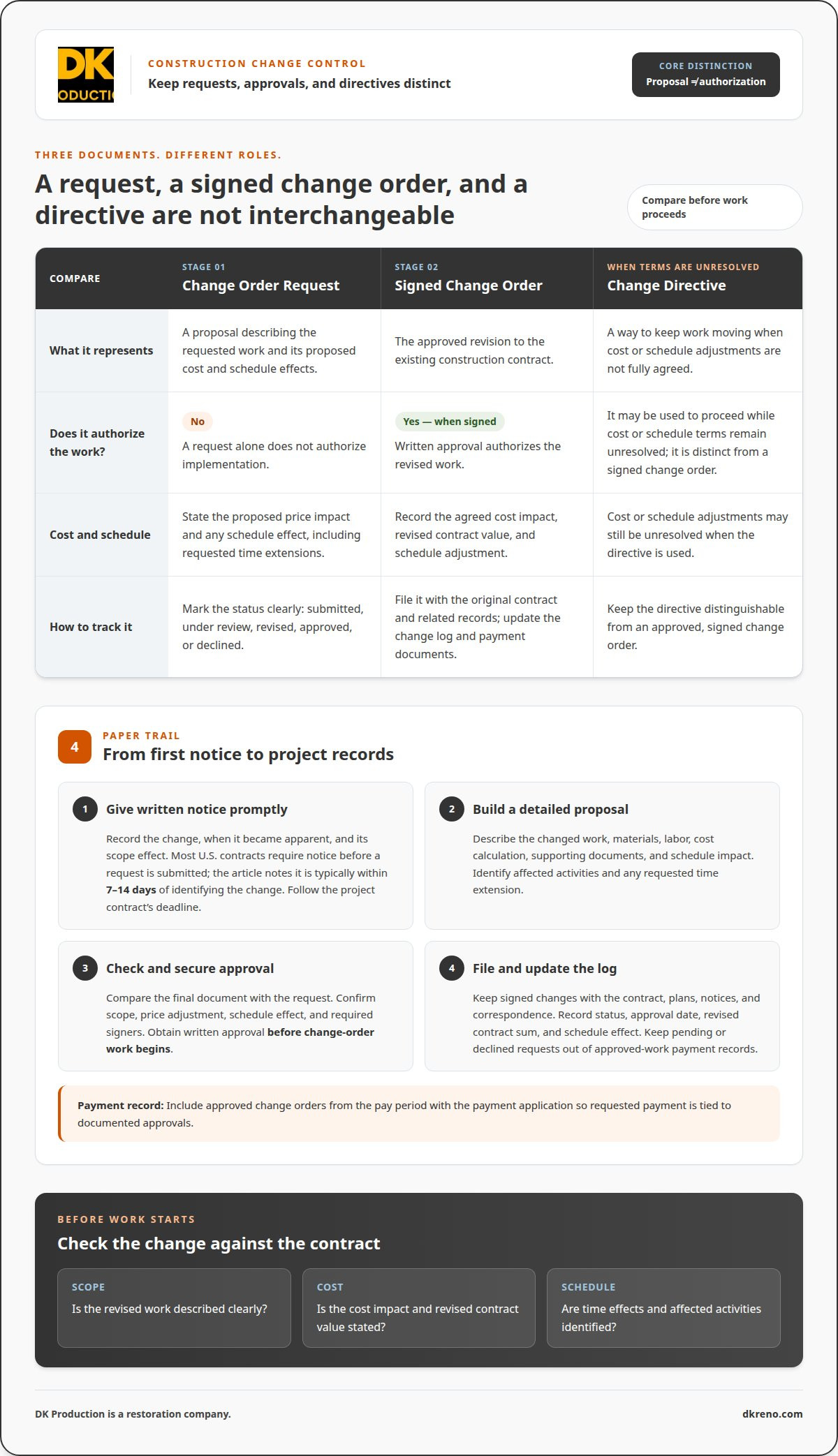
Keep a consistent paper trail from first notice through final payment. This separates a request from authorized work and keeps project records aligned.
Submit written notice promptly. Record the change, when it became apparent, and its effect on the scope of work. Most U.S. contracts, including AIA and ConsensusDocs contracts, require written notice before submitting a change order request, typically within 7-14 days of identifying the change. Follow the notice process and deadline in your construction contract.
Distinguish Requests from Approved ChangesLabel a proposal as a Change Order Request until the required parties approve it. A request presents proposed work and its cost and schedule effects; it does not by itself authorize implementation. For example, a request to replace specified flooring still needs review and approval before the substitution becomes part of the agreed project scope.Track its status as submitted, under review, revised, approved, or declined. This prevents a pending proposal from being mistaken for permission to proceed and gives each party a clear record of outstanding decisions.
Prepare a detailed proposal. Describe the changed work, materials, labor, cost calculation, supporting documents, and schedule impact. State any requested time extension and explain which project activities it affects. A total without a breakdown of the work it covers is harder to assess and connect to the revised scope.
Obtain Written Approval Before WorkSecure the required written approval before change-order work begins. Compare the final document with the request, checking the agreed scope, price adjustment, schedule effect, and signers. A signed change order authorizes the revised work. Starting first can lead to disagreement about whether the work was approved and whether payment is due.If the contract requires a specific form, use it. For example, AIA contract documents may require the AIA G701 Change Order Form.
Document Approvals and Unapproved ChangesFile each signed change order with the original contract, plans, notices, and related correspondence. Update the project change log with its status, approval date, revised contract sum, and schedule effect. Clearly mark declined or pending requests; don’t record them as approved work or authorized changes in payment records.Include approved change orders from the pay period with the payment application. This ties requested payment to documented approvals and helps catch omissions before processing.
Track review and payment status. Record when each proposal is submitted, reviewed, approved, and included in a payment application. Approval can take time; federal agencies can take months or even years to approve and pay construction change orders. For a home addition, a clear log also helps connect approved scope revisions with the project schedule. Explore home additions and whole-house remodeling as you plan a residential project.
Construction change directives when cost or time is unresolved
A construction change directive can authorize work before the parties settle its cost or schedule impact. Under AIA A201, Article 7 addresses interim and final adjustments when a contractor disagrees with a directive.
Compare Change Orders and DirectivesFirst, determine whether the proposed change is a signed agreement or an instruction to proceed. A change order records agreed terms between the parties; a directive can require work to move forward while cost or time remains unresolved. Don’t treat a directive as proof that the contractor accepts the final adjustment.For example, if revised plans require a different installation sequence, a directive may address the immediate work while the parties assess the resulting labor and schedule. Keep the directive and related records in writing, then continue the change order process to establish the final adjustment.
Check whether an ASI fits. An architect’s supplemental instruction, or ASI, may be used only when the change does not affect contract cost or schedule. For example, a clarification that leaves both unchanged may fit this route. If the revision adds expense or delays expected work, an ASI alone does not capture those adjustments; use the change process set out in the contract.
Address Change Directive Cost DisputesDocument disputed items as work proceeds, including labor, materials, and schedule effects. Compare the contractor’s cost records with the directive and original contract scope. Separate agreed amounts from contested ones, and record each party’s position in writing rather than treating an estimate as the final adjustment.Under AIA A201, Article 7 provides procedures for interim and final adjustments when the contractor disagrees with a directive. If the contractor disagrees with the architect’s determination of the final cost, the dispute proceeds under AIA A201, Article 15. Follow the contract’s stated process and preserve supporting records.
Track interim payment separately. A directive can leave the final amount unsettled, so keep payment records tied to the directed work and its documented progress. The Small Business Payment for Performance Act would require federal agencies to make interim partial payments to contractors for unilateral changes directed by buying agencies. This describes the Act’s proposed requirement, not a general payment rule for every project.
Move unresolved terms toward agreement. As work progresses, update the cost and schedule assessment using project records. Identify what remains contested, what has been resolved, and what evidence supports each adjustment. Once the parties agree, document the final terms through the applicable signed change order. This brings the directive and the contract’s revised terms into alignment.
Additive, deductive, and no-cost change orders
Classify a proposed change by its effect on the original contract sum. The type clarifies the financial adjustment, but the document should also capture scope and schedule effects.
Use an additive change order when work is added. Identify each new task, material, and responsibility, then show how the added work changes the contract sum. For example, adding built-in shelving to a remodeling plan expands the original scope. Describe the shelving, installation, and related work so the owner and contractor can assess what the amendment covers.Don’t rely on a label such as “extra work” alone. Link the addition to the relevant plans or specifications, and record any schedule effect. An additive change can affect more than price if it alters sequencing or the expected completion date.
Use a deductive change order when work is removed. List the deleted tasks or materials and explain how removing them reduces the contract sum. A homeowner who removes a planned built-in cabinet, for instance, should document both the omitted installation and the corresponding adjustment. A deductive change order can reduce both the work and the contract price.Check whether related work remains necessary. Removing one finish item may not remove preparation or installation work included elsewhere. State what remains in scope so the contractor and owner can distinguish a true deduction from a substitution.
Record a no-cost change when the scope shifts without a price adjustment. For example, an owner and architect may agree to substitute a comparable finish while keeping the contract sum unchanged. Identify the original item and replacement clearly, and document the parties’ agreement. “No cost” describes the price effect, not whether the change matters to the project.Check schedule and performance details independently. A substitution with no contract-sum adjustment could still affect delivery timing or installation sequence. Record those effects, even when the agreed price remains unchanged, to keep the revised scope clear.
Choose the type by comparing the revised work with the original contract. Ask whether the change adds work, removes it, or changes it without adjusting the price. An unforeseen condition may lead to any of these outcomes, depending on the agreed work. The reason for the change alone doesn’t determine its type; the resulting scope and contract adjustment do.
Keep the amendment complete and consistent. Tie the change order to the affected drawing, specification, or scope item, and state the revised contract sum and schedule effect. This makes later review easier when payment records are compared with approved changes. For remodeling planning, organize your project scope before revisions make the agreement harder to follow.
DK Production Restoration: Restoration
DK Production Restoration provides water mitigation, restoration, and reconstruction for homeowners dealing with water damage. Turn to the team when property damage calls for a coordinated path from mitigation to repairs, with project changes documented as the agreed scope develops.
For a restoration project, tie each approved change to the affected work, any schedule adjustment, and the written agreement. This helps distinguish necessary revisions from work outside the approved scope and keeps project records clear through reconstruction.
Contact DK Production Restoration to discuss restoration for your home.
Carry Clear Decisions Into Your Next Project
When change orders in construction are explained in plain language, homeowners can make project decisions with greater clarity. Before a renovation begins, agree on how questions will be raised, who needs to review decisions, and where project records will be kept. A shared process helps keep conversations productive when plans shift, without treating every revision as a setback.
At the project kickoff, discuss priorities, decision-making, and how updates will be communicated. Revisit those expectations as work progresses, especially when a new choice could affect the finished space. Keeping the conversation open helps everyone focus on the home’s needs and the outcome you’re working toward. Thoughtful decisions can move the project forward with purpose.
If property damage or restoration work is part of your plans, contact DK Production Restoration to discuss a next step for your home.
Frequently Asked Questions
What Counts as Additional Work?
Additional work is a task or material outside the agreed scope. For example, installing an extra electrical outlet counts if the original plans and contract don’t include it. Compare the request with the contract documents, including drawings and specifications. If those documents already require the work, it may be part of the existing obligation rather than an added change.
What Is Extra Work in Construction?
Extra work is construction work added beyond the original agreement, often after a new request or site condition arises. A homeowner might ask to add storage during a renovation, or concealed damage might require repairs beyond the planned work. The key question is whether the task falls outside the agreed scope. Describe it separately so it isn’t confused with correcting incomplete work already required by the contract.
What is a construction change order?
A construction change order is a formal amendment to the existing construction agreement. It records an agreed revision, such as changing a specified finish or removing an item from the work. Unlike an informal conversation, the document connects the change to the parties’ contractual commitments. A clear explanation of change orders in construction helps homeowners distinguish a proposed adjustment from one accepted into the agreement.
What are common reasons for construction change orders?
Common triggers include an owner’s design preference, an architect’s revision, an unforeseen condition uncovered during work, or a correction to project documents. For example, opening a wall might reveal damage that wasn’t visible during planning. A change can also remove or substitute specified work. The reason matters because it explains why the scope changed and supports a clear record of the decision.
What is the process for requesting, approving, and documenting a change order?
Start by describing the proposed change and identifying the affected plan, specification, or task. Submit it under the notice and review process in the construction contract, then record responses and revisions. Before work proceeds, ensure the approval document reflects the final scope and required signatures. Keep the approved version with the project file, and clearly mark replaced drawings so the team doesn’t rely on outdated plans.
How are change order costs and prices calculated?
Cost is generally assessed from the changed work: labor, materials, and any overhead and profit terms in the contract. A deduction should account for removed work, while a substitution should compare both the deleted and replacement items. Request a breakdown that connects quantities and tasks to the revised scope. For homeowners in Mukilteo, Marysville, Lake Stevens, Snohomish, Lynnwood, Mill Creek, Mountlake Terrace, Brier, Edmonds, Arlington, Woodway, Stanwood, Monroe, Granite Falls, Sultan, Gold Bar, Darrington, Index, and Bothel, the project documents provide the basis for reviewing the adjustment.



Comments