
Understanding a Construction Bid and How Contractors Set Prices

The bid total is only one part of the decision. A construction bid is a contractor’s priced offer to complete defined work under stated terms. Understanding a construction bid means looking beyond the total to the scope, cost assumptions, schedule, and contract conditions. Winning the bid does not necessarily mean work starts immediately: contract signing and pre-construction come next, followed by authorization to begin.
It’s natural to focus on price when comparing bids, but a clear scope and realistic estimate show what each offer covers. The award is an important milestone, not the point when work automatically begins.
This article explains how bidding works, how contractors estimate costs, and what negotiated bidding involves. It also follows the process beyond contractor selection, covering contract preparation, pre-construction coordination, and the notice to proceed, so you can see how a bid becomes an active project.
Table of Contents
What is construction bidding?
Construction bidding is the process of submitting priced offers for defined work under stated project requirements. Understanding a construction bid means reviewing its scope, price, terms, and submission requirements together, rather than judging the total alone.
Bid Contents and Submission Requirements
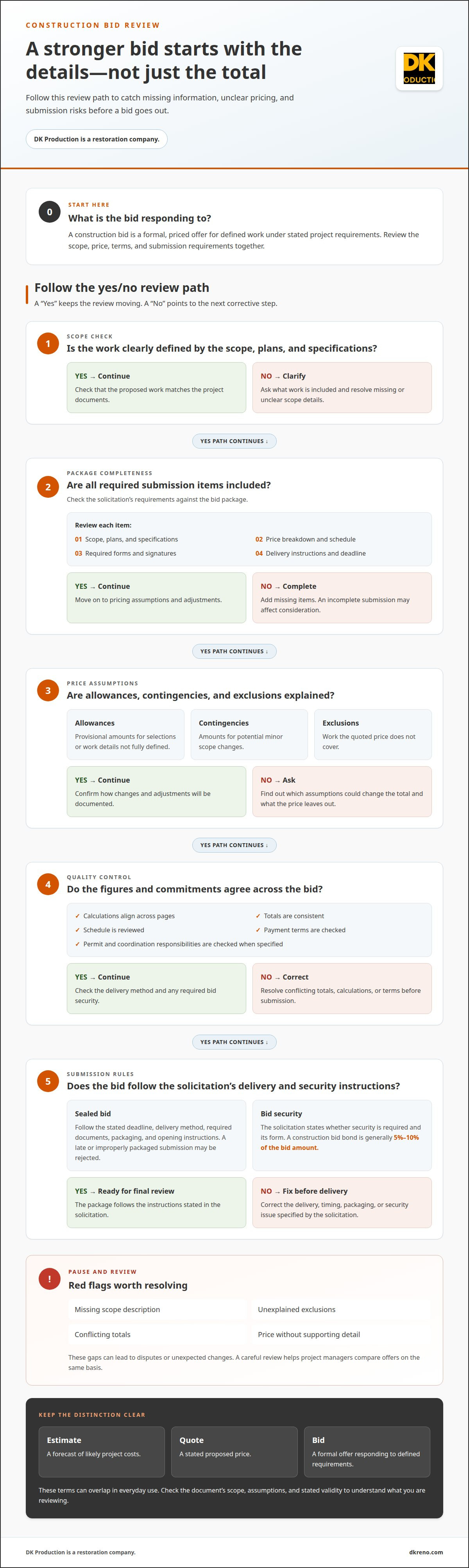
A construction bid is a formal offer responding to a project solicitation. Its format matters because missing information can make a submission incomplete. The solicitation may specify project requirements, contract type, project delivery method, and bonding and insurance requirements.
Before submitting, compare the bid package against a checklist: scope, plans, specifications, price breakdown, schedule, required forms, signatures, and delivery instructions. Contractors should understand the request for proposals, clarify uncertainties, and allow enough time to meet the deadline. A complete package supports fair selection and helps the project manager compare offers on the same basis.
Estimates, Quotes, and Bid Adjustments
An estimate forecasts likely project costs; a quote states a proposed price; a bid is a formal offer responding to defined requirements. These terms can overlap in everyday use, so check the document’s scope, assumptions, and stated validity to understand what you’re reviewing.
Allowances set provisional amounts for selections or work details that are not fully defined, while contingencies account for potential minor scope changes. Exclusions identify work the price does not cover. For example, if a remodeling bid excludes an item shown in the plans, the owner may need to budget for it separately. Ask which assumptions could change the total and how adjustments will be documented.
Submission Review and Bid Risks
Quality control means checking the bid against the solicitation before submission to reduce errors that could affect a competitive bid. Confirm that every requested form is included, calculations align across pages, and the proposed work matches the plans and specifications.
Ask what work is included, which selections remain allowances, what exclusions apply, and how changes are priced. A thorough review also checks the schedule, payment terms, and responsibilities for permits or coordination when those are specified in the bid. Red flags include a missing scope description, unexplained exclusions, conflicting totals, or a price without supporting detail. These gaps can lead to disputes or unexpected changes.
Sealed Bids and Bid Security
A sealed bid is submitted in a secured format and opened according to the process stated in the solicitation. Public solicitations may specify the deadline, delivery method, required documents, and opening instructions. Follow each instruction precisely, as a late or improperly packaged submission may be rejected.
Bid security, often a bid bond, supports the bidder’s commitment to proceed under the bid’s stated terms. A construction bid bond is generally 5% to 10% of the bid amount. The solicitation explains whether security is required and what form it must take. For a homeowner reviewing a bid, distinguish this submission security from the project’s final contract terms and any later bond requirements.
Contractor estimating and market knowledge
A contractor’s estimate turns project documents into a budget by pricing labor, materials, equipment, and overhead. A material takeoff identifies the quantities needed, then applies current pricing and labor assumptions. Direct costs relate to specific work activities; jobsite overhead may include supervision, safety, and utilities. Site conditions, design choices, and schedule also shape the estimate. In remodeling, demolition may reveal hidden framing, electrical, or plumbing issues that change the work required.
Market knowledge helps contractors assess whether materials and labor can be obtained when needed. It can also help identify risks from price changes, access limits, or incomplete selections. Ask which assumptions drive the estimate and how uncertain work is accounted for. A contingency can cover minor concerns, such as modest scope changes, without renegotiating the entire contract. Clarify what the contingency covers and how its use will be documented.
Common billing structures allocate cost and risk differently. A unit-price contract itemizes completed work by unit, which can suit projects with uncertain scope or duration. A guaranteed maximum price sets a ceiling, with the contractor absorbing additional costs. A cost-plus contract charges project costs plus fees for overhead; unclear terms around change orders can lead to disputes. Compare each method with the project scope, budget, and need for flexibility.
For U.S. projects, licensing and contract requirements vary by state and project type. The bid and final agreement should identify applicable requirements, scope, insurance, payment terms, and how changes are approved. Payment schedules may include an initial deposit, progress payments tied to completed work or milestones, and a final payment. The contract should state when each payment is due and what work or documentation triggers it.
Contract formation turns the selected offer into a signed agreement. Confirm that the contract reflects the accepted scope, price structure, schedule, and negotiated changes before signing. For the public projects described, performance bonds are typically 100% of the contract value, according to the Federal Acquisition Regulation (FAR) Council. After award, a contractor typically has 10 days to return signed contract documents with bonds and insurance certificates.
Work typically moves through contract signing and pre-construction before authorization to begin. The notice to proceed marks that authorization and gives the project team a clear start point under the agreed terms. Before it is issued, confirm that the plans, selections, responsibilities, and schedule align across the contract documents. A clear record helps clients and contractors manage changes without confusing preliminary planning with approved work.
Negotiated bidding benefits and drawbacks
Negotiated bidding lets an owner work directly with a chosen contractor to settle the scope, price, and terms. Unlike competitive bidding, it places less emphasis on comparing multiple offers, so clear records and capable negotiation are especially important.
Negotiated Bidding and Residential Projects
For a residential project, the owner and contractor can discuss design priorities, material choices, schedule, and budget before finalizing the agreement. This dialogue can tailor the work to the home and support a long-term partnership across related projects.
The tradeoff is fewer competitive checks on price. Without competing proposals, owners may have less insight into whether costs or proposed methods are competitive. Negotiation may also bring less cost-driven innovation. Keep a written record of the agreed scope, assumptions, changes, and pricing. The method’s success depends on both parties’ capabilities and communication.
Selective Bidding: Expertise and Efficiency
Selective bidding invites a chosen group of contractors, often after prequalification. It can help owners match specialized work with contractors who have relevant expertise, while a smaller field can make proposals more efficient to review.
That screening takes time and resources before bids arrive. A narrow candidate pool can also limit competition, so selection criteria should reflect the project’s complexity. For example, when evaluating a complex renovation, an owner could consider experience with similar work alongside the proposed scope and schedule.
Serial Bidding and Repeat Work
Serial bidding uses a contractor repeatedly across projects, which can reduce the need to renegotiate pricing or terms each time. Familiarity with the property and working process may also make coordination easier for owners managing several related stages.
There is a concentration risk: relying on one contractor can create complications if availability changes or performance declines. Owners can preserve flexibility by documenting each project’s scope and reviewing progress before committing to later work. A successful previous project is useful context, but it should not replace an evaluation of the next project’s specific needs.
Preparing for Construction Bidding Exams
For learners preparing for a construction bidding exam, study how scope connects to price: reading plans, identifying quantities, estimating labor and materials, and recognizing contract terms. Practice with a sample project by tracing each listed task to its corresponding cost assumption.
Then review bidding scenarios involving negotiated, selective, and serial methods. Explain each tradeoff, such as tailored collaboration versus reduced price competition. This approach tests whether you can apply construction bidding concepts to decisions rather than simply memorize definitions.
Award, pre-construction, and notice to proceed
Winning the bid is a selection milestone, not an automatic start date. The owner still needs to confirm the accepted proposal, complete contract formation, coordinate pre-construction details, and authorize the work. These steps connect the construction bidding process to the first day on site.
From Bid Review to Award
After bids arrive, the owner or project team evaluates them against the solicitation’s requirements. Public construction bid evaluations typically take 1-2 weeks, and protests can extend that period. A competitor typically has about 5 business days to protest a public bid when they believe proper processes weren’t followed.
The award identifies the selected contractor and proposal, but the selection should follow the stated evaluation method. On commercial projects, owners may also consider experience, safety record, and scheduling philosophy alongside price. For a homeowner, the practical step is to confirm that the chosen proposal accurately reflects the agreed scope and terms.
Contract Signing and Pre-Construction
Once an award is made, contract documents turn the accepted proposal into the working agreement. The parties align the scope, price structure, schedule, insurance, required bonds, and responsibilities for approvals or selections. Changes made during negotiation should appear in the final documents so the contract and proposal do not conflict.
For a public construction project, contract signing and pre-construction typically take 1-3 weeks. During this period, the team can coordinate plans, materials, site access, scheduling, and communication. A typical public design-bid-build project takes approximately 2-3 months from completed drawings to breaking ground. That span includes more than bid selection, so an award alone doesn’t determine when crews begin.
Notice to Proceed and the Start of Work
The notice to proceed is the owner’s authorization for the contractor to begin work under the agreed contract. It establishes a clear starting point for scheduling and coordination. Before it is issued, confirm that the signed scope, current plans, required approvals, site access, and start arrangements match the project team’s understanding.
For example, if material selections remain unresolved, the schedule may need to be coordinated before work starts. If site access arrangements differ from the proposal, the project team should settle the details before mobilization. These checks help distinguish planning activity from authorized construction.
The key takeaway: an award selects a proposal, pre-construction aligns the project, and the notice to proceed authorizes the start. Track each milestone separately, because a winning bid does not mean work begins immediately.
DK Production Restoration: Restoration
DK Production Restoration provides water damage restoration for residential properties. Turn to its water mitigation and restoration services when a home has sustained water damage and needs recovery work, or when reconstruction is needed to return the property to its pre-loss condition.
Understanding the bid is one part of planning; coordinating the work after damage is another. Restoration connects the response to the repairs a home needs, while reconstruction addresses the rebuilding phase. Clear project details help define the work and support an organized path toward recovery.
To learn about restoration services, visit dkreno.com.
Move from planning to a clear next step
Understanding a construction bid can help you make a more confident decision, but the next step is connecting the written scope to your home’s condition. If water damage has changed what needs to be done, updated project details can clarify the work before restoration moves forward.
DK Production provides water damage restoration, water mitigation, and reconstruction for residential properties affected by damage. Its work supports homeowners moving from mitigation toward repairs and rebuilding, with the goal of returning the home to its pre-loss condition.
Bring your questions about the project scope and recovery needs into the conversation, so the path forward feels more organized. Contact DK Production Restoration to discuss restoration for your home. Each clear step can help make the way back to a comfortable, usable space feel more manageable.
Frequently Asked Questions
What is bid leveling?
Bid leveling is a side-by-side review that makes competing proposals easier to compare on equivalent terms. Check whether each bidder priced the same work, treated alternates consistently, and included the requested items. For example, one proposal may list a finish as an allowance while another prices a specific selection. Flagging the difference helps explain why totals vary and prevents a lower headline figure from hiding a gap in scope.
What Is Construction Estimating?
Construction estimating is the process of forecasting the resources and expenses needed to complete defined work. An estimator can use drawings, site observations, labor assumptions, and supplier or subcontractor input to develop the forecast. The level of detail depends on how clearly the project is designed: an estimate at the concept stage has more open assumptions than one based on complete specifications. Owners can use that distinction to understand how firm an estimate is.
What Is a Bid Schedule?
A bid schedule is usually a table listing the work items bidders must price, often with quantities, units, and spaces for unit prices or totals. It gives the owner a consistent structure for comparing the same categories of work. Do not confuse it with a construction schedule, which shows the planned sequence and timing of project activities. If the term appears in a package, the surrounding columns and instructions indicate which meaning applies.
What does a construction bid look like?
A construction bid often opens with the project name and bidder’s details, followed by a price table and supporting terms. A sample line might identify “cabinet installation,” its unit or quantity, and the bidder’s amount; other pages may show alternates or assumptions. The exact layout varies by solicitation. Look for a clear connection between each priced line and the work described in the plans, rather than relying on the total alone.
What is Bid Tabulation?
Bid tabulation is a record of submitted bids arranged for review, commonly showing each bidder’s total and relevant line-item prices. It helps an owner or project team compare offers and identify entries that need closer examination. For instance, a tabulation can make a large difference in one work category easy to spot. It records the comparison, but does not by itself explain every scope difference or determine which proposal best fits the project.
What is a construction bid and what does it include?
A construction bid is a contractor’s offer to perform specified work for proposed terms and pricing. It may include the project scope, itemized amounts, schedule assumptions, proposed contract terms, and stated exclusions or alternates. For a homeowner, the useful test is whether the document connects the proposed amount to identifiable work. If a line is unclear, mark it for discussion before comparing it with another proposal.



Comments